The way we mix live drums in our template is based on the ideas of Andrew Scheps, the engineer who mixed Red Hot Chili Peppers, Adele, Metallica, Jay-Z and Hozier. In September 2024 Pavel spent a week at his Mix With The Masters seminar at La Fabrique in France, and what he heard there changed a lot about how we approach live drums.
Why Scheps barely compresses the drums directly
Scheps's idea sounds counterintuitive at first. The individual drum tracks and the drum group get almost no compression, so the drums keep their life and dynamics. Density, energy and the feeling of a big mix come from a set of parallel buses instead, which you blend in as gently as the arrangement asks for.
That way the dry drums stay alive and dynamic (don't forget EQ), and when you need it you can add density, sustain, crunch and controlled aggression. We put parallel compression for live drums in S in our tier list: density without losing dynamics.
Drum Crush
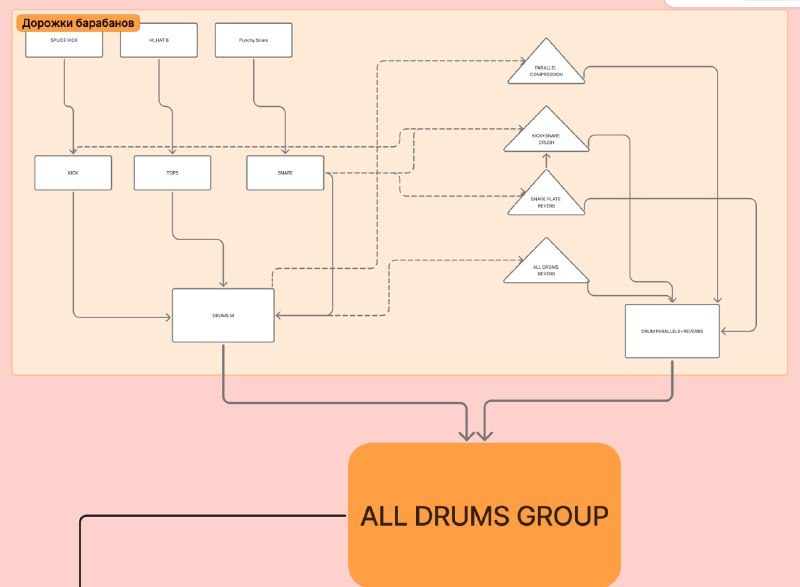
What we call Drum Crush is a Puigchild 670 set to Time Constant 1 with 4–5 dB of gain reduction, and it's the main parallel drum bus. Its job is to blend the "middle levels" into the drum group. It doesn't so much emphasize the loudest peaks as fill the space between the hits. That makes the drums denser and more solid in the mix without losing definition.
A well-set Drum Crush shouldn't sound like a separate effect. It should sit inside the overall drum picture, so it feels like the drums just got bigger and closer.
Drums Dirt
A parallel saturation bus. The Omnipressor adds dirt, texture and analog crunch to the drums, but because it works in parallel, the main sound stays clear and natural.
Kick+Snare Crush
A bus that gets only the kick and snare mics, to make them cut through and bring out the transients. It uses a dbx 160 doing 2–3 dB of gain reduction.
Automating the parallels by section
All three buses then come together on one Drum Parallels bus. Andrew often automates its level by section: pulling it out completely in the verses and bringing it in for the choruses. That lets you shape the dynamics inside the mix and push the big moments. That's the real strength of parallel processing: it controls the energy of the mix without wrecking the natural dynamics of the source drums.
We showed how the drums sound with and without the parallel processing in a video on our channel.
What if the drums need more space?
Once the parallel compression and saturation are set, you can judge whether the drums have enough space. If the room mics don't sound big enough, or there just aren't many in the recording, two extra kinds of reverb come in:
- An overall convolution reverb to glue things together: Sound City Studios or something like it. It stands in for room reverb; you don't clearly hear it, but it adds size.
- A snare plate: a short reverb on the snare mics that colors the snare's tone. Usually a short VerbSuite, Magic 7 or Pro-R. Dialed in right, it often feels less like a separate reverb and more like part of the snare's own sound.
After that everything goes into a Drum Parallels+Reverbs group, which joins the Drums M track on the ALL DRUMS GROUP bus. You can see it on the diagram above; the rest of the routing is in our template breakdown.
FAQ
What is parallel drum compression?
We send the drums to a separate bus, compress them there and blend that back in with the main signal. The main sound keeps its life and dynamics, and the parallel bus adds density. On our buses the compressors do 2–5 dB of gain reduction.
Which compressor should go on the parallel drum bus?
In the Scheps method: a Puigchild 670 on the Drum Crush bus (Time Constant 1, 4–5 dB) and a dbx 160 on a bus for just the kick and snare (2–3 dB). The Omnipressor adds dirt and crunch in parallel.
Does this only work for live drums?
Scheps's method is about live drums specifically. But our template has sends to parallel compression and saturation for every track, and whether we use them depends on the genre: rock and dense hip-hop will definitely get more parallel compression than a romantic piano ballad.